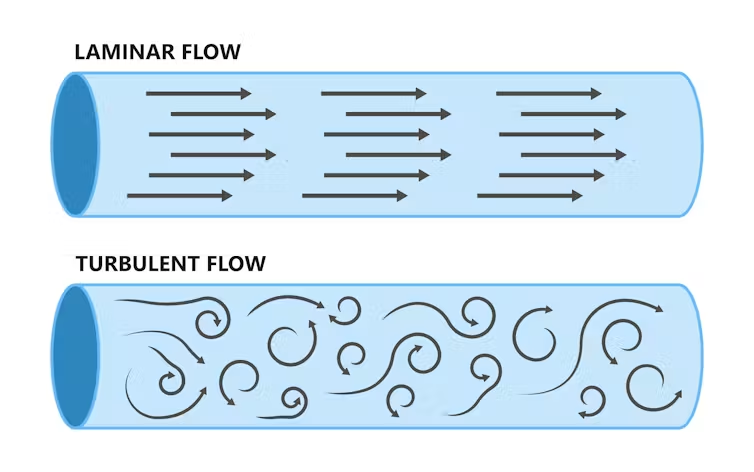
Airflow turbulence is one of the most troublesome phenomena in fluid dynamics. In simple terms, turbulence describes air that no longer moves in a smooth orderly way, but instead breaks into irregular swirls, or “eddies”, with fluctuating velocity patterns. By contrast, laminar flow is calm and predictable, which behaves in a more uniform way. Laminar flow is typically the desired condition when designing systems and conducting tests.
Turbulence appears chaotic, yet it follows physical rules that engineers can measure, model and, to some degree, control. Understanding where turbulence starts and how it behaves is essential in everything from aircraft design to ventilation systems.
At the heart of turbulence is the balance between inertia and viscosity. Inertia pushes the air to keep moving, while viscosity acts like internal friction that resists deformation. Engineers often describe this balance with the Reynolds number, a dimensionless value that compares inertial forces with viscous forces. Low Reynolds numbers tend to support laminar flow, while high Reynolds numbers make turbulent motion more likely.
Another key concept is the boundary layer, the thin region of air next to a surface where velocity changes rapidly from zero at the wall to the free-stream speed away from it. As disturbances grow inside this layer, the flow can transition from laminar to turbulent, increasing mixing, momentum transfer and drag.
Large rotating structures (like the fans which drive a wind tunnel) introduce eddies (swirls of turbulence) into the flow and can turn a laminar flow into a more turbulent flow. Because turbulent flow changes from moment to moment and point to point, it is usually analysed statistically rather than tracked exactly in every detail.
These fundamentals become especially important in wind tunnel applications, where the goal is to reproduce real-world airflow conditions in a controlled environment. Whether testing an aircraft wing, a vehicle, a building model or an F1 component, researchers must decide how much turbulence is present, how it is generated and whether it matches the conditions being simulated.
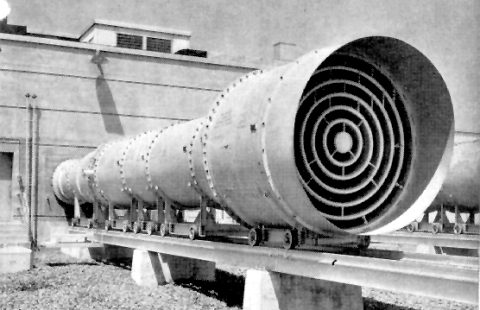
Cullum flow screens are used to create low turbulence flow. The honeycomb structure smooths turbulence/eddies, this allows test engineers to reintroduce just the right amount of turbulence to simulate the desired conditions.
Picture credit- University of Melborne